

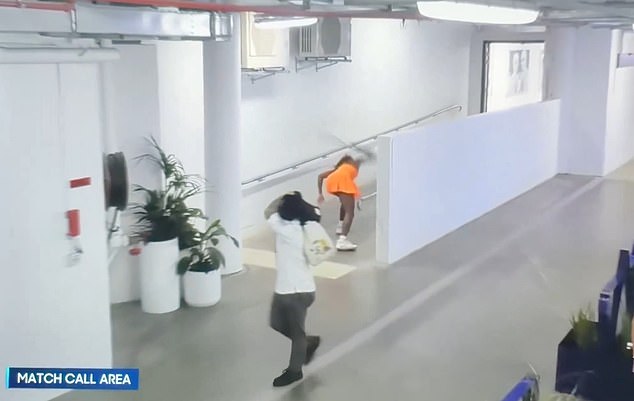
The racket hit the concrete again and again as the world No 3 let every ounce of frustration fly. Coco Gauff was off the court, away from the roaring crowd, convinced she had finally found a sliver of privacy after a brutal 59-minute defeat.
She had not. The cameras were already rolling.
Within moments, Gauff’s behind-the-scenes meltdown at the Australian Open was on television, clipped for social media, and replayed across the world. A young superstar’s rage, a shattered racket, and a bigger question that refuses to go away. How much of an athlete’s pain are we really entitled to see?
The 59 Minute Collapse
On paper, Gauff’s loss to Elina Svitolina was as lopsided as it gets. The American fell 6-1, 6-2 in their quarter final, struggling from the very first game to find any rhythm in the arena where she had arrived as a genuine title contender.
The numbers were brutal. Gauff produced 26 unforced errors and only three winners, with five double faults and no aces. Her average first serve speed hovered at just 94 mph, a far cry from the heavy, intimidating delivery that helped carry her to the US Open title.
As the second set slipped away, the usually composed 21-year-old looked lost. At one changeover, she walked to her courtside box and asked her team, essentially, what do I do now. Her biomechanics coach, Gavin MacMillan, offered the kind of advice you would give a nervous club player, not a two-time Grand Slam champion.
“Just aim for the middle of the court, that’s it for now,” he told her.
Gauff’s game has long carried a strange contradiction. Her athleticism and mental grit are elite, yet the two most basic strokes in tennis, the serve and the forehand, remain works in progress. She fights a wandering ball toss on serve that makes her contact point inconsistent, and a long, looping forehand backswing that can unravel under pressure.
“There was a lot that didn’t go well today,” Gauff admitted later. “But bad days are often caused by your opponent. She did well.”
The opponent did more than that. Svitolina made the court feel small, and the occasion feel suffocating, and when it was over, Gauff finally cracked in the only place she thought she was safe.
When the Cameras Follow You Off Court
Backstage at Melbourne Park, away from the formal post-match handshake and the polite wave to the crowd, Gauff let the mask drop. She took her racket and drove it into the floor, again and again, a private storm exploding after an hour of horrendous tennis.
Only it was not private at all. The Australian Open has quietly become tennis’s own Big Brother experiment. More cameras in more “backstage” spaces, more unseen reactions and raw emotions captured in real time. UK broadcaster TNT Sports showed Gauff’s outburst live and then shared the clip widely online.
For Gauff, it crossed a line.
“I have a thing with the broadcast,” she said after the defeat. “I feel like certain moments, they don’t need to be broadcast.”
She revealed that she had actively tried to escape the lens.
“I tried to go somewhere where I thought there wasn’t a camera, because I don’t like breaking rackets,” she explained. “I broke one racket at the French Open, and I said I would never do it again on court, because I don’t feel like that’s a good representation.”
This time, she thought she had outsmarted the system.
“I went somewhere where I thought they wouldn’t broadcast it, but obviously they did,” she said. “Maybe some conversations can be had, because I feel like at this tournament the only private place we have is the locker room.”
After her quarterfinal loss, Coco Gauff has suggested “conversations” should be held on player privacy at the Australian Open after she smashed a racket in a place she thought was private — and saw it broadcast to the world.https://t.co/7rDHo26ohp pic.twitter.com/Ep6KbPhqhg
— The Athletic (@TheAthletic) January 27, 2026
On TNT Sports, retired doubles star Jamie Murray was sympathetic to the reaction, saying that a “very disappointing performance from Coco was rightfully taking it out on the racket at the end of that.” His co-pundit, former British No 1 Laura Robson, added a gentle caveat before asking viewers to consider if an on-court racket toss might have been a healthier release.
Fans devoured the footage. It was compelling, shocking, and strangely intimate. It was also a reminder that in modern sport, the red recording light never really blinks off.
Inside Tennis’s New Surveillance War
If Gauff’s smashed racket felt uncomfortably close, it is because this is quickly becoming tennis’s new normal. Grand Slams are racing to pump out clips that feel unscripted and raw, building entire content machines around locker room corridors, player tunnels, and lounges once considered off limits.
The images of Iga Swiatek sobbing in relief after a nerve-shredding win over Naomi Osaka at the French Open are still seared into many memories. The moment was powerful and human, but it also left plenty of fans wondering whether they had witnessed something that was never meant to be shared so widely.
At the same time, top players are increasingly pushing back, not with formal boycotts but with their own cameras. Jannik Sinner, Daria Kasatkina, and Ben Shelton are among those producing personal video blogs, trying to wrestle back some control over how their stories are told.
It is part of a larger fight between stars and the sport’s biggest stages. Prize money is one front. Image and narrative are another. The more tournaments lean into backstage surveillance, the more players seem determined to build their own channels, their own edits, and their own versions of backstage reality.
Gauff’s frustration lands right in the middle of that tension. She is commercially savvy and media trained, but also protective of how she is seen, especially in the heat of anger.
To her, smashing a racket off camera was not about keeping who she is. It was about keeping one messy, human moment for herself.
The Other Woman on Court
Lost in the psychodrama surrounding Gauff was a career-defining night for Elina Svitolina. While cameras chased the defeated star down the hallway, the Ukrainian veteran quietly walked into her first Australian Open semi-final.
Svitolina, 31, has rebuilt her career after stepping away from the tour to have her daughter, Skai. She is married to French player Gael Monfils, and in the space of two years back in competition, she has surged into the top 10 again and is now two wins away from something historic.
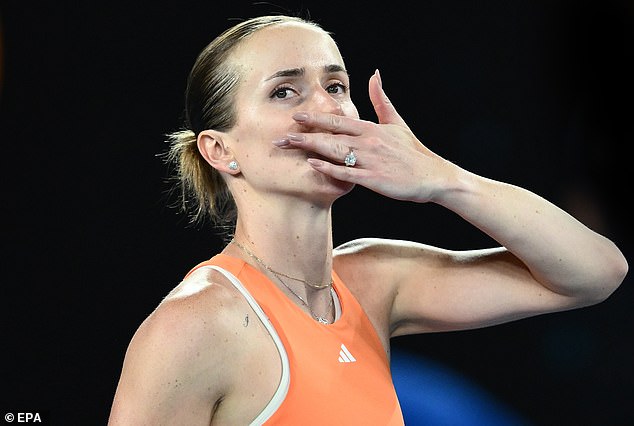
If she lifts the trophy in Melbourne, she will become the first mother to win a Grand Slam singles title there since Kim Clijsters in 2011, and the first Ukrainian player ever to claim a major singles crown.
For Svitolina, the stakes are far bigger than personal legacy.
“It was one of the toughest winters for Ukrainian people, without electricity and everything,” she said. “So I feel like to bring a little light, even just positive news to Ukrainian people, to my friends, it’s a great feeling.”
She has already beaten two Russian opponents at this tournament, including their top-ranked Mirra Andreeva, and now faces world No 1 Aryna Sabalenka of Belarus. Every win is another headline, another sliver of good news for a country still gripped by war and hardship.
On the day Gauff’s rage clip circled the globe, Svitolina’s calm, methodical performance was almost a supporting storyline. Yet her run in Melbourne carries the weight of nationhood, motherhood, and a second career blooming after many assumed her peak had passed.
How Much Is Too Much?
In the age of infinite angles, the most unforgettable image from this quarter final was not a forehand winner or a fist pump at match point. It was a young champion in an empty hallway, smashing a racket while a quiet camera watched from above.
For some viewers, that rawness is exactly what makes modern sport irresistible. For others, it is starting to feel less like access and more like an intrusion.
Coco Gauff has already lived a lifetime in the spotlight, from teenage phenom to Grand Slam winner and now to a reluctant star of a viral meltdown. Her message after Melbourne was simple. Not every moment needs to be content.
Whether tennis listens is another story. As long as the cameras keep creeping closer and the clicks keep rolling in, the line between public performance and private emotion will stay dangerously thin.
Somewhere in a locker room, a new generation of champions is watching and quietly deciding how much of themselves the world will be allowed to see.