

TLDR
A new protest group, Take Back Power, has seen eight members charged after a crumble-and-custard strike on the Crown Jewels and a manure dump under The Ritz Christmas tree.
In a country that treats the Crown Jewels and The Ritz as part of its emotional wallpaper, the images were designed to sting. Apple crumble sliding down the glass, shielding the Imperial State Crown. A mound of manure piled beneath a glittering Christmas tree in the lobby of London’s most fabled hotel.
Police say all eight suspects are linked to Take Back Power, a fledgling protest movement whose mantra is “tax the rich to fix Britain.” Four have been charged over the manure stunt at The Ritz in Piccadilly, four over the Tower of London action, and a ninth person faces a separate theft charge after an alleged organized shoplifting incident at a Sainsbury’s in Lewisham.
At The Ritz, prosecutors say Ellen Redwood-Brown, 23, Tom Barber, 66, Toby Ellwood, 21, and Tjalle Rumley, 26, emptied bags of manure beneath the hotel’s lobby Christmas tree. Security guards moved quickly as the brown heap spread across the luxury carpet, and guests watched the scene unfold in a space more associated with afternoon tea than protest.

Outside, activists sat on the pavement, waving flags bearing a harsh slogan about inequality and a call to tax the rich. Redwood-Brown, described as an NHS worker, later identified herself as a participant. “The billionaires, corporations, and corrupt politicians running Britain don’t care about us,” she said. Barber, a former doctor, added: “Power is concentrated in the hands of a small group of obscenely wealthy and ruthless individuals.”
Redwood-Brown and Barber are due at Westminster Magistrates Court, with Ellwood and Rumley scheduled to appear later in April.
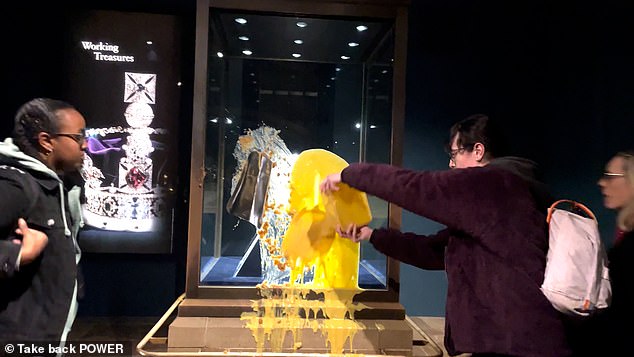
Three days after the Ritz protest, attention shifted from hotel opulence to royal symbolism. At the Tower of London, crumble and bright yellow custard were smeared across the glass case that protects the Imperial State Crown, a centerpiece of royal pageantry worn by the monarch at coronations and state occasions.
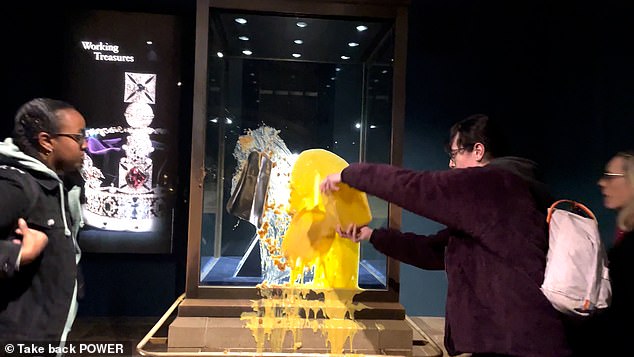
Fatima Ali, 19; Miriam Cranch, 22; Mack Preston, 22; and Matthew Cooper, 50, have been charged with criminal damage in relation to that second demonstration. The group is set to appear at Westminster Magistrates’ Court in late April.
Footage shared by Take Back Power shows one activist lifting a foil tray of apple crumble from a bag and slamming it into the glass. Another pours custard over the front of the case, which once held the crown seen atop Queen Elizabeth II’s coffin and later on King Charles at his coronation.
As tourists looked on, the activists unfurled a sign reported to read “Democracy has crumbled, tax the rich” and opened their coats to reveal T-shirts printed with “Take Back Power.” One demonstrator declared, “Britain is broken. We’ve come here to the jewels of the nation to take back power. Join us at takebackpower.net.”
After the commotion at The Ritz, a spokesperson for Take Back Power framed the stunts as a response to inequality, saying the super-rich had more than doubled their wealth since the pandemic, while “a third of UK children suffer and grow up in poverty.” The group argued that “ordinary people” should help decide how wealth is taxed through a legally binding citizens assembly they describe as a “House of the People.”
Following the Crown Jewels action, the group cited tax figures, claiming that since 2011, the poorest 10 percent of households have paid a combined tax rate of 44 percent on income and wealth gains, compared with 22 percent for the richest. “Our political class, be it this government, Reform or Tory, serve the super-rich; they do not care about working people,” the group said, urging a “citizen-led assembly that has the power to tax the rich.”
The ninth suspect, David Kilroy, 66, has been charged with theft over the alleged Sainsbury’s incident and is due at Bexley Magistrates Court, extending the legal shadow from glittering ballrooms and royal vaults to an ordinary supermarket aisle.
For royal watchers and lovers of old-world London luxury, the case lands at the crossroads of class anger, political theatre, and deep emotional attachment to Britain’s most carefully guarded symbols.
Do protests that target royal treasures and grand hotels go too far, or are they the only way to force a conversation about wealth and power in modern Britain?