

The Image That Stops You Cold
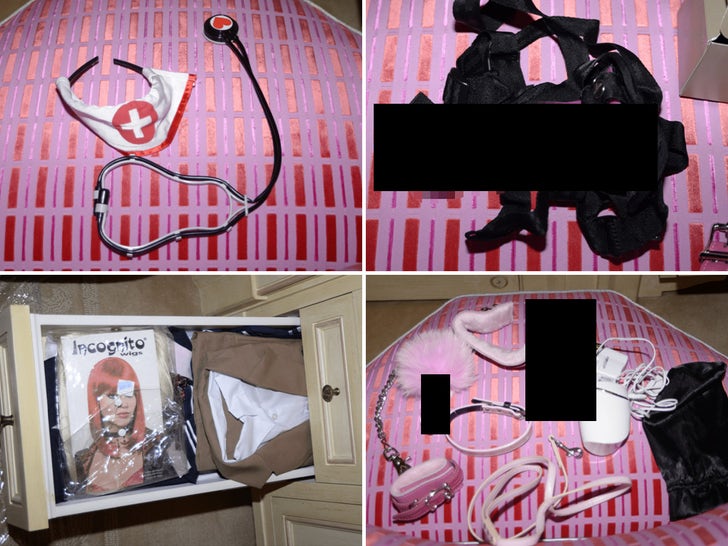
Dog collars on a billionaire’s dresser. A stethoscope beside a nurse’s headband. Wigs labeled to help the wearer disappear. That is the world frozen in new photos tied to Jeffrey Epstein, and now released by the U.S. Department of Justice.
The images, part of the so-called Epstein files, peel back the polished surface of a man once welcomed in the highest social circles and expose the disturbing personal inventory federal agents collected when his double life finally collapsed.
They are not just snapshots of sex toys. They are evidence, and they are a chilling reminder of what was hiding in plain sight while Epstein moved through the worlds of finance, politics, and celebrity.
The Chilling Inventory Behind the Townhouse Doors
According to photos released by the Department of Justice and reported by TMZ, Epstein’s private space was stacked with items that read like a prop list for a dark fantasy.
There were dog collars and vibrators. A stethoscope. A nurse’s headband. Costumes that appear to have been used for role play, folded and waiting in drawers instead of hanging in a costume closet.
One drawer contained a package marked “Incognito Wigs,” an almost too-on-the-nose detail for a man later accused of running a globe-spanning network to exploit minors.
On a nearby surface, investigators documented a book that seems to have been a favorite. A copy of “Erotica Universalis” sat among his belongings, featuring erotic illustrations from some of the world’s most celebrated painters, including Rembrandt, Picasso, and Matisse. The cover itself shows a naked couple engaged in oral sex, an explicit art-world mirror of the sexualized environment Epstein built around himself.
What the DOJ Photos Actually Show
The Justice Department images are clinical. There is no glamour in them, only evidence laid out, tagged, and frozen in time from the moment federal agents swept through Epstein’s Manhattan townhouse.
Some photos focus on the sex paraphernalia itself, arranged neatly in drawers and on shelves. Others capture the broader setting, where luxury architecture and high-end decor collide with the kind of items more often associated with fetish shops and adult theaters.
The contrast is jarring. There is the world Epstein presented to guests and power players, all marble and money. Then there is the world he prepared behind closed doors, where collars, toys, and costumes suggest carefully curated scenarios and power games that now exist only as exhibits inside federal files.
On its own, a book of erotic art or a bag of wigs is not a crime. In the context of a convicted sex offender accused of trafficking minors, these objects become something much darker. They are physical reminders of the environment victims described to investigators and in court filings, now preserved in government archives.
From Billionaire Facade to Federal Evidence
The FBI seized these items during a search of Epstein’s Manhattan residence around the time of his arrest in July 2019 on federal sex trafficking charges involving minors.
For years before that, Epstein had cultivated an image as a brilliant financier with extraordinary connections. He was photographed with presidents, princes, CEOs, and Hollywood names, moving comfortably through a world where power, fame, and money blur together.
That image shattered when federal prosecutors brought new charges and agents descended on his properties searching for anything that could support the accounts of victims. The toys, costumes, and books that now sit in DOJ case files were part of that sweep, collected not as tabloid fodder but as potential evidence in a high-stakes criminal case.
Epstein was later found dead in his cell at the Metropolitan Correctional Center in New York in August 2019. Officials ruled his death a suicide. He never faced a full trial, and the evidence the government gathered, including these seized items, became part of a sprawling archive that many Americans have long demanded to see.
The Slow Drip of the Epstein Files
Under federal law, the Department of Justice is required to release the Epstein files. TMZ reports that the bill mandating that release was signed by President Donald Trump.
Yet, despite that legal requirement, the process has been slow. TMZ notes that less than 1 percent of the total files have been made public so far, even though there are reportedly more than 2 million additional documents in the full collection.
This new batch of photos is part of that small fraction, a carefully measured window into a much larger body of material that remains behind government doors. For the public, and especially for victims, the pace has been a source of deep frustration.
The release of any new fragment, even a set of images documenting sex toys and costumes, carries weight. It signals that the government is still moving, however painstakingly, toward full transparency about a case that shook faith in institutions, raised questions about elite protection, and exposed how long powerful men can operate without consequence.
Why These Images Still Grip Us
On one level, the contents of Epstein’s drawers are not surprising. After years of investigations, lawsuits, and media coverage, the world already knows that he was a convicted sex offender whose life revolved around exploitation and secrecy.
Yet the photos land differently. They are not abstract allegations or secondhand accounts. They are the literal objects he kept close within a townhouse that once hosted some of the most influential people on the planet.
The dog collars, the “Incognito Wigs,” the erotic art book with a graphic cover, all of it turns a sprawling scandal into something uncomfortably intimate. You are not just reading about abuse and power. You are looking at the physical tools that were part of that world.
That is why each incremental release from the Epstein files hits with such force. Every document, every photo, every inventory list tightens the focus on how he lived and how much others knew, or chose not to know, while standing beside him at parties and boarding his private planes.
The Secrets Still Locked Away
The DOJ’s photo trove may satisfy a certain dark curiosity, but it is also a reminder of how much is still hidden. For every wig photographed, there are thousands of pages of interviews, financial records, flight logs, and internal communications that the public has not yet seen.
TMZ reports that millions of additional documents remain unreleased, even as federal law requires their disclosure. Victims, transparency advocates, and an increasingly skeptical public are still waiting to learn which names appear where, what warnings were missed, and how Epstein managed to operate in plain sight for so long.
In the end, the most disturbing thing about the Epstein photos may not be the toys themselves. It is the reminder that they are only a sliver of the full story, a handful of objects in a case built on silence, power, and delayed accountability.
The question now is not just what Epstein kept in his drawers. It is what still sits in locked federal filing cabinets, and how long it will be before the rest of those secrets see the light.