

If you ever paused “LA Confidential” to admire the moody motel where Jack Vincennes pulls in, or binged an old episode of “The Rockford Files,” you have already been there. Now the place where those scenes were shot exists only on screen and in memory.
The Motel That Always Looked Like A Movie
The Hollywood Center Motel was built in 1905 as a Craftsman-style building tucked just off Sunset Boulevard. Long before it became a filming staple, it was simply one of those modest, workhorse properties that quietly held up the neighborhood. Wood details, low-slung rooflines, a layout that never tried too hard. It looked real, because it was.
That authenticity turned it into a magnet for directors. The motel appeared in the Oscar-winning noir “LA Confidential” and the movie “Hit Man,” along with television staples including “The Rockford Files,” “Perry Mason” and “TJ Hooker.” On screen it could be anything. A shady rendezvous point, a cop’s stakeout spot, a place where secrets were exchanged under buzzing neon.
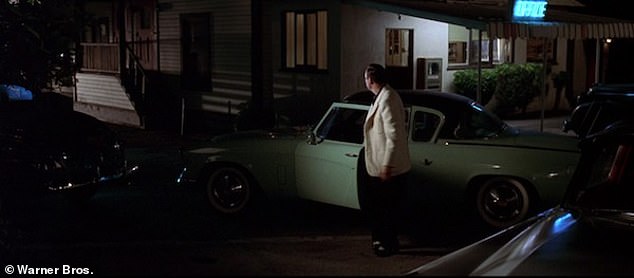
For decades, Hollywood producers went back to the same aging corridor, knowing the motel could still sell gritty glamour better than any studio backlot. If you love that specific Los Angeles look on film, the feeling that every wall has heard something, the Hollywood Center Motel delivered it in a single establishing shot.
From Rock Icons To A Run-Down Relic
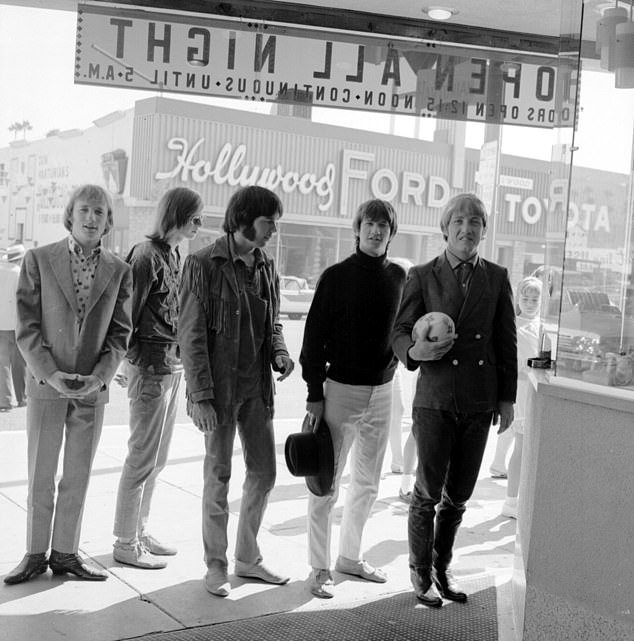
Its legend is not just about cameras and close-ups. In its heyday, the motel also pulled in actual rock stars. Members of Buffalo Springfield stayed there during the 1960s, as did Neil Young and his band Crazy Horse. Imagine those narrow hallways filled with cigarette smoke and half-finished lyrics, guitars jammed against floral bedspreads, the sound of a new West Coast era rattling the thin walls.
Over time, though, the star power faded. According to public records, the motel’s business operation was shuttered in 2018. The building did not go quiet overnight. The former owner and some long-time tenants continued to live there until the property was foreclosed and vacated in late 2024.
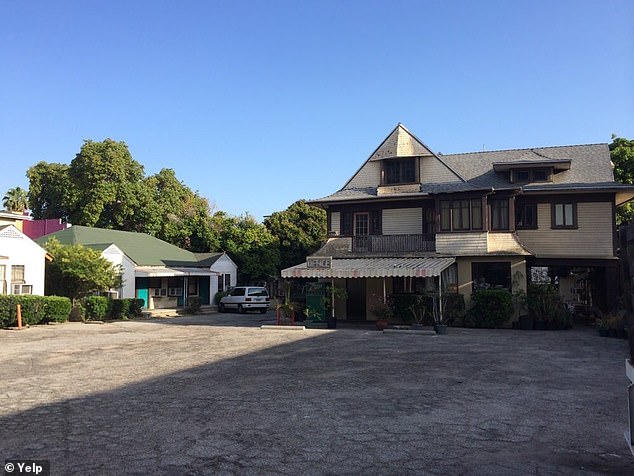
Once it was left empty on paper, it was never really empty. The boarded-up structure became a de facto shelter spot for homeless individuals and others seeking any kind of roof. Authorities documented at least two smaller fires at the site in the second half of 2025, as the property slipped further into neglect.
The current owner, Andranik Sogoyan, tried to secure the motel, installing fences and sealing off access. People cut through the barriers. Athena Novak, a representative for Sogoyan, told the Los Angeles Times that the owner also “had a maintenance man going there all the time,” who “was attacked a few times with weapons.” The building was being pulled in two directions. It was a crumbling historic set piece and a desperate refuge at the same time.
The Night The Hollywood Center Motel Burned
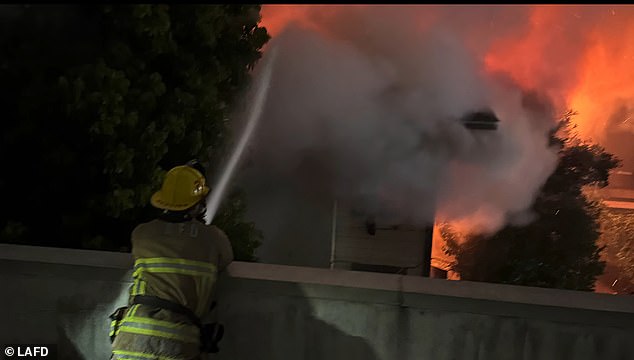
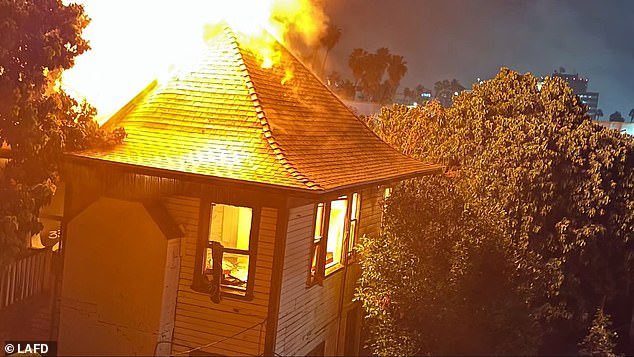
The fire that finally destroyed the motel began as a report of a trash fire on the property, according to the Los Angeles Fire Department. Crews responded in the early morning hours, around 4:30 a.m., to the boarded-up two-story structure. When firefighters arrived, they found large flames already bursting from both floors and quickly upgraded the call to a structure fire while requesting backup.
Inside, people who had been sheltering illegally were suddenly trapped in a real-life disaster that looked like something out of the very shows filmed there. Many scrambled out and spilled onto Sunset Boulevard. One 42-year-old man did not make it down in time. Firefighters heard calls for help from inside, saw that he had broken a window on the second floor, and used a tall ladder to reach him.
They brought him to safety and treated him at the scene for a minor arm injury before transporting him to a nearby hospital in stable condition. Officials reported that he did not suffer burn injuries.
It took about 70 firefighters roughly an hour and twelve minutes to fully knock down the blaze. After a careful search, crews found no additional victims inside the charred remains, and no firefighters were injured while battling the fire that erased a piece of Hollywood history.
“A Gem In The Community” That Slipped Away
The most haunting part is that the Hollywood Center Motel was on the verge of official protection. Just weeks before the fire, a local cultural committee had voted to consider preserving the building as a historic resource. The nonprofit group Hollywood Heritage, which works to protect the neighborhood’s past, had pushed hard for recognition.
In a statement, Hollywood Heritage mourned what could have been. “The building could readily have been painted and preserved to serve in an adaptive re-use capacity as a gem in the community,” the organization said. It was a pointed reminder that age and wear do not make a site worthless. They make it irreplaceable.
The group did not hold back its frustration either. “By allowing its decay and neglect we again see rare historic buildings lost which were eminently restorable.” It was a verdict on more than one address. The statement echoed across a city where century-old hotels and motels are often treated as disposable, right up until the moment people realize that history is gone.
Ironically, the push to save the motel had picked up speed after the owner submitted demolition permits to remove parts of the structure in early 2025. According to reports, Sogoyan was open to adapting his plans if the building was officially landmarked, and Hollywood Heritage had even scheduled a webinar to highlight the motel’s history.
That online event will now pivot. Instead of celebrating a fragile survivor, it will serve as a memorial and a strategy session on how to keep the next Hollywood relic from meeting the same fate.
Another Fire, Another Lost Album Cover
For preservationists and nostalgic fans, the fire at the Hollywood Center Motel stings even more because it is not an isolated tragedy. Around one year earlier, the 111-year-old Morrison Hotel, another downtown Los Angeles landmark, was also consumed by a blaze and destroyed.
The Morrison Hotel is famous to music lovers as the building featured on the Doors’ fifth studio album. Its facade, captured forever on the “Morrison Hotel” cover, became shorthand for a whole era of rock mythology. Like the Hollywood Center Motel, it had become popular among homeless residents before the fire, another structure caught at the crossroads of cultural memory and present-day crisis.
Two buildings, two fires, two very different but equally iconic pieces of music and film history gone within a short span of time. The pattern is hard to ignore. Locations that lent their faces to some of the most enduring images in pop culture are quietly disappearing between development pressures, safety concerns, and chronic neglect.
When The Location Only Exists On Screen
What makes the loss of the Hollywood Center Motel feel so personal for many fans is the way film and television embed real places into our emotional lives. That motel is not just a background in “LA Confidential” or “The Rockford Files.” It is part of the mood of those stories. It is where a character pulls up, where a crucial conversation happens, where you feel the grit and glamour of old Los Angeles soak through the frame.
Now, when you revisit those scenes, you are watching something that cannot be visited anymore. The camera angle becomes an archive. The door Kevin Spacey’s character walks through does not open onto anything but air and ash. What once was a film location you could still drive past has turned into a ghost address.
For the people who lived there in recent years, the story is even more stark. A place that once provided low-cost rooms for rock bands and travelers ended as a last resort for those with nowhere else to go. Their scramble to escape the fire is now part of the motel’s history too, a reminder that nostalgia and reality are always colliding in Los Angeles.
How Many More Hollywood Ghosts In Waiting
The fire at the Hollywood Center Motel has already sparked tough conversations about how the city handles its aging landmarks. Preservationists argue that early investment and adaptive reuse can turn worn-out properties into vibrant community assets, instead of letting them sit empty until they are dangerous. Developers point to the cost and complexity. Neighbors worry about crime and fire risk in boarded-up buildings.
Somewhere in the middle is that feeling you might have right now, realizing a filming location and rock hangout you half-recognized has vanished almost overnight. The next time you stream “LA Confidential” or stumble onto an old “Perry Mason” rerun, you might see that weathered motel sign and feel a quick jolt. It is the bittersweet thrill of recognizing a place that is both everywhere on screen and gone in real life.
Hollywood will keep telling stories. Directors will keep finding new angles on crime alleys and roadside motels. But the originals, the spots that quietly anchored some of the greatest scenes and wildest nights, are not infinite. The Hollywood Center Motel had already lived a thousand lives in our collective imagination. Now the question is whether its fiery ending will finally push Los Angeles to protect the next hidden landmark before it, too, disappears into the credits.