

TLDR
Catherine Harding says a security guard connected to pop star Chappell Roan intimidated her 11-year-old daughter, Ada, at a Sao Paulo hotel, leaving the child in tears and skipping a birthday concert, while Roan distances herself from the guard.
A Birthday Trip Turns Sour
For Catherine Harding, a birthday trip to Brazil was supposed to be pure magic. The singer, who shares an 11-year-old daughter, Ada, with Jude Law, traveled to São Paulo with her husband, Brazilian soccer star Jorginho Frello, so Ada could finally see her new favorite artist, Chappell Roan, onstage.

According to Harding, things spiraled in the hotel restaurant before the show even began. She says Ada spotted someone she believed might be Chappell Roan at a nearby table. The preteen, who Harding notes is used to being around well-known people through her stepfather, did not have a phone, did not ask for a photo, and did not approach the table.
Harding says Ada simply walked past to check if it really was the singer. That was when, Harding claims, a man she understood to be Roan’s security guard confronted mother and daughter so harshly that Ada ended up crying in the bathroom and later chose to skip the concert that had been her birthday present.
“She literally did not do anything, she just looked at her,” Harding recalled in an Instagram video, describing Ada coming back to their table confused and upset. The family, she says, had flown in specifically for the show, only to watch the evening unravel.
Harding Questions: Who Is Representing Whom
Harding decided to speak publicly after Frello shared his anger about the encounter on social media. His post drew attention to Roan’s treatment of fans, particularly young girls who see themselves in the flamboyant, fiercely independent star.
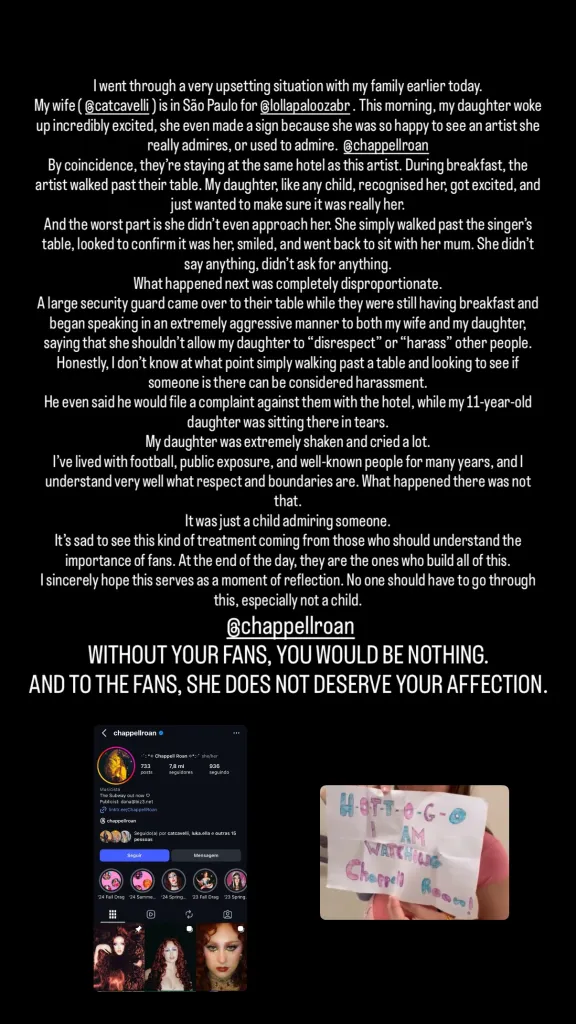
Roan responded with her own Instagram video, saying the man at the hotel was not part of her personal security team and that she was never approached by Harding or Ada. She framed the incident as something that happened around her, not because of her.
Harding, however, told followers she did not believe he was with the hotel. She described him as someone who “looks after artists,” raising a broader question about celebrity accountability.
“Did she send him to do it? Again, I do not know,” Harding said. “I would like to hope not, but at the same time, I think that you have a responsibility when you are a celebrity to make sure that the people who work for you and act on your behalf are acting on your behalf.”
If the guard did not have that authority, Harding argued, “then obviously that is a big problem because then he is representing her in a way she does not want to be represented.” For Harding, the issue is less about a single tense moment and more about how power circulates around a star’s name, even when they insist they were not directly involved.
Chappell Roan’s Complicated Boundaries With Fame
The story lands at a delicate moment in Chappell Roan’s career. The 28-year-old “Pink Pony Club” singer has built a devoted fan base on theatrical costumes, queer joy, and the sense that she is deeply accessible to her audience, which has lifted her from cult favorite to pop phenomenon.
That intimacy has always had an edge. According to previous interviews, Roan has spoken about feeling overwhelmed by sudden attention and the need to set firmer limits around fan interactions, especially in private spaces like hotels and airports. The Brazil incident throws those boundaries into sharp relief.
Harding was careful to separate the artist from the behavior that upset her daughter. “I think she is a very talented artist. I like her a lot,” she said, adding that the family came “all the way to Sao Paulo” for the show. Yet she also admitted the night felt “a little bit ruined” when Ada, still shaken, chose not to go.
What emerges is a clash between two realities. On one side is a young fan who believed she was doing everything right, staying respectful and keeping her distance. On the other is a rising star fighting to protect her personal space in an industry that rarely offers any. Between them stand the people paid to enforce those invisible lines, whose split-second decisions can shape a child’s memory of her favorite singer forever.
Where should the line be between a celebrity’s right to privacy and a young fan’s hope for a brief, respectful moment of connection?