

The Group Chat No One Was Meant To See
Pop’s biggest superstar, a gossip girl icon, and a Hollywood director caught in the crossfire. Newly unsealed court documents have cracked open the private text messages between Taylor Swift and Blake Lively, and the language about director Justin Baldoni is far from polite.
In messages quoted in legal filings tied to the film adaptation of “It Ends With Us,” Lively calls Baldoni a “clown” and a “doofus director,” while Swift refers to him as a “bitch” with a “tiny violin.” It is a rare, unfiltered glimpse into how A-list friendships and movie power dynamics can collide behind closed doors.
The texts, described in documents obtained by Page Six, now sit at the center of a growing legal drama around the romantic drama “It Ends With Us” and just how involved Taylor Swift really was.
‘Doofus Director’ and a ‘Clown’ on Set
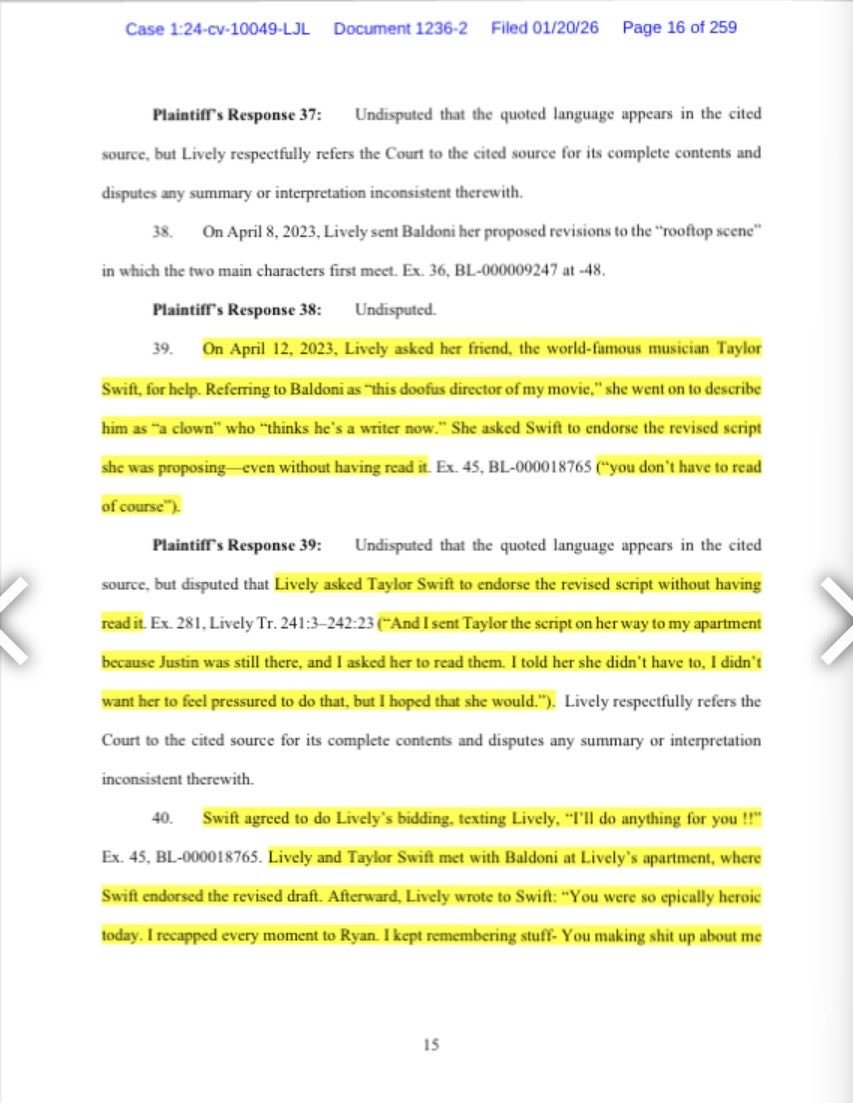
According to the court filing, Blake Lively vented about Baldoni, her director and co-star in “It Ends With Us,” in private texts to Taylor Swift. In those messages, she reportedly referred to him as the “doofus director of my movie” and a “clown,” painting a picture of a deeply strained working relationship.
The documents also claim that in April 2023, Lively asked Swift to endorse her revised version of the “It Ends With Us” script before the singer had even read it. Baldoni’s legal team says Swift was immediately supportive.
“Swift agreed to do Lively’s bidding, texting Lively, ‘I’ll do anything for you!!’,” the filing states.
That loyalty would soon move from text bubbles into the room.
Inside the Apartment Meeting Swift ‘Heroically’ Backed
The documents describe a meeting at Lively’s apartment where Swift, Lively, and Baldoni reportedly discussed Lively’s script changes. According to Baldoni’s lawyers, Swift backed her friend’s vision for the film.
After that meeting, Lively sent Swift a breathless recap that now reads like a fan letter to one of the world’s most powerful friends. In a message quoted in the filing, Lively wrote, “You were so epically heroic today. I recapped every moment to Ryan [Reynolds]. I kept remembering stuff. You’re making s–t up about me and lenses. And referring to yourself as my doll. This clown is falling for all of it. But also resisting it. You are the world’s absolute greatest friend ever.”
That single text does two things at once. It shows Lively clearly fuming over her director, and it underlines how central Swift was in the room, at least from Lively’s point of view.
The Trailer, the Song, and the Power Play
By April 2024, the texts had shifted from script pages to soundtrack power. At issue was one very high-stakes song choice. Taylor Swift’s own “My Tears Ricochet With Us” and whether it should appear in the trailer for “It Ends With Us.”
The filing states that in text messages from that month, Swift and Lively discussed a plan to use the track in marketing. According to the documents, Swift wrote, “If Justin was strategic, he would be like no Taylor Swift in the trailer because that gives you more power over the film, that’s your ally, not his.”
Lively’s response, as quoted in the court papers, was just as blunt. “You are so right…He should’ve run from your music…How stupid. This was his only shot at having the appearance of an upper hand,” she replied.
It is a master class in behind-the-scenes leverage. To Swift, her music is more than a soundtrack. It is an ally that can tip the balance of power around a film. To Lively, Baldoni had mishandled his one chance at that kind of perceived control.
The ‘Tiny Violin’ Text Before a Bombshell Story
The legal filing also points to messages from December 2024, just before a widely discussed New York Times article about “It Ends With Us” and its production issues.
In one text cited in the papers, Swift allegedly wrote to Lively, “I think this bitch knows something is coming because he’s gotten out his tiny violin.” The “bitch” in question, according to the documents, is Baldoni.
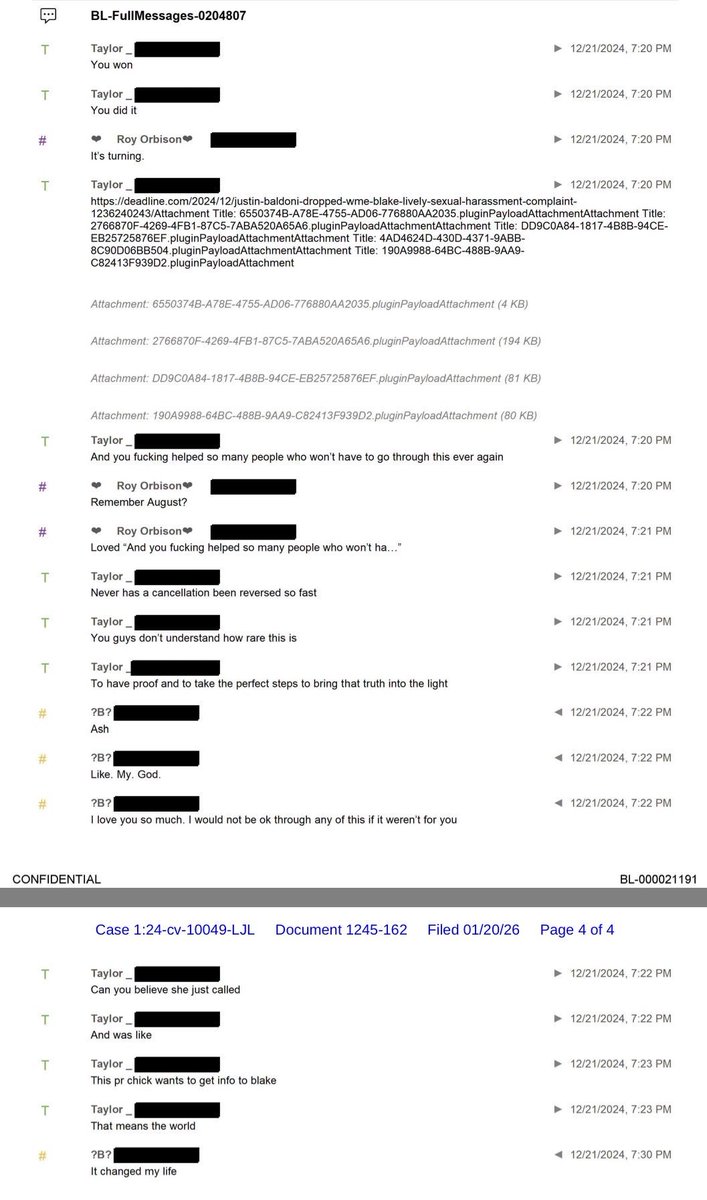
That line, short and stinging, is the one that has dominated headlines. It suggests Swift believed Baldoni sensed trouble ahead. The court records link the timing of the text to the looming Times piece, which went on to raise serious questions about the film’s set and creative control.
Lively, in her own response included in the same filing, denies that she and Swift coordinated around the New York Times story. She also pushes back on the idea that Swift endorsed her script revisions without seeing them.
“And I sent Taylor the script on her way to my apartment because Justin was still there, and I asked her to read them,” Lively states in the documents. “I told her she didn’t have to, I didn’t want her to feel pressured to do that, but I hoped that she would.”
The ‘Dragons’ and a Director Who Felt Cornered
Baldoni’s filing does not just focus on the texts. It also describes how the director allegedly felt in the presence of Blake Lively and her inner circle, especially Ryan Reynolds and Taylor Swift.
The documents reference messages in which Lively affectionately referred to Swift and Reynolds as her protective “dragons.” Baldoni’s legal team argues that this translated into real-world pressure during creative disagreements.
“The message could not have been clearer,” Baldoni’s lawyer wrote in the filing. “Baldoni was not just dealing with Lively. He was also facing Lively’s ‘dragons,’ two of the most influential and wealthy celebrities in the world, who were not afraid to make things very difficult for him.”
It is an image that feels straight out of a prestige drama. A director caught between a movie star lead and two of the most famous entertainers on the planet, all while a best-selling book adaptation turns into a legal saga.
Swift’s Camp Draws a Sharp Line
As the texts ricocheted across the internet, Taylor Swift’s team made one thing crystal clear. They want distance between her and the actual making of “It Ends With Us.”
In a statement to Page Six in June 2025, a representative for Swift said, “Taylor Swift never set foot on the set of this movie, she was not involved in any casting or creative decisions, she did not score the film, she never saw an edit or made any notes on the film, she did not even see ‘It Ends With Us’ until weeks after its public release, and was traveling around the globe during 2023 and 2024 headlining the biggest tour in history.”
It is a sweeping denial of any formal creative role. Yes, Swift is in the texts. Yes, her song was in play for the trailer. Yes, she was in Lively’s apartment when the script was discussed. But her camp is adamant that she was never a producer, never part of the set, and never an official decision maker on the film.
More Than a Group Chat, It Is a Power Map
For fans, these messages are addictive because they feel like a stolen glance at a real celebrity group chat. The nicknames. The jokes. The unfiltered venting. We see Blake Lively hyping up her friend in real time. We see Taylor Swift shifting from playful to pointed with a single line about a “tiny violin.”
But for Hollywood, the texts are a roadmap of power. They show how a global pop star’s music can become a bargaining chip, how a beloved actress can lean on her famous friends, and how a director can suddenly find himself described in legal filings as facing down “dragons.”
It is also a striking snapshot of where these stars are now. The actress who once ruled “Gossip Girl.” The teenager who started in Nashville and now headlines record-breaking stadium tours. The actor-director who took on a hit Colleen Hoover adaptation. All colliding over one movie and a handful of messages that were never meant to leave their phones.
The court battle will play out on paper. The film will live or die with audiences. But these texts have already done something else. They have reminded everyone just how much drama can live in a few blue and gray bubbles, especially when the names at the top of the screen are Taylor, Blake, and Justin.