

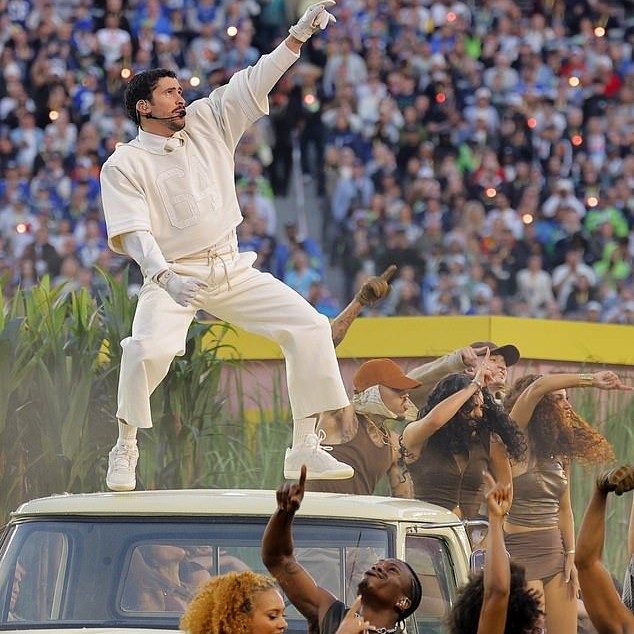
It was supposed to be Bad Bunny’s crowning pop-culture coronation, an all-Spanish Super Bowl halftime show packed with stars, spectacle, and a message of unity. Instead, it collided headfirst with Donald Trump’s fury, lighting up the culture wars before the confetti even settled.
TLDR
Donald Trump attacked Bad Bunny’s all-Spanish Super Bowl halftime show as a slap at American values and “nothing inspirational,” while supporters praised the set as a lavish, emotional tribute to Latin and Hispanic culture.
A Culture Clash on Turf
The Super Bowl stage has always doubled as a mirror for American identity. This year, that mirror reflected Spanish lyrics, Caribbean rhythms, and a vividly Latin visual story that unfolded across the field at Levi’s Stadium in California.
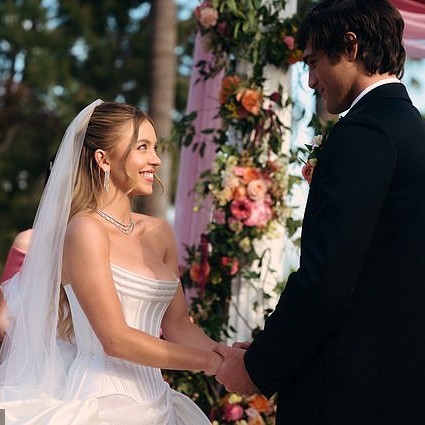
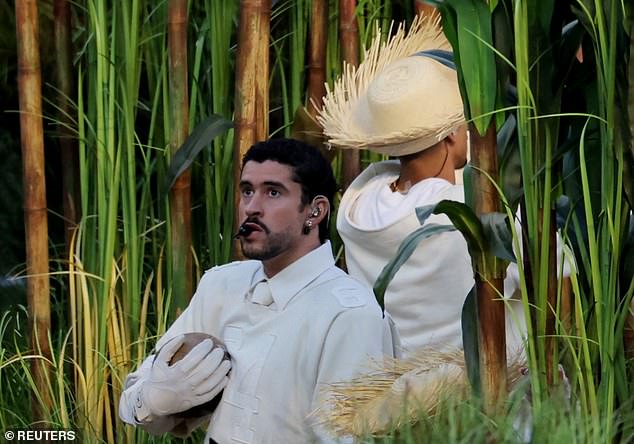
Benito Antonio Martinez Ocasio, known globally as Bad Bunny, built his halftime performance as a love letter to the Americas he knows. According to DailyMailUS, the field transformed into a sugarcane landscape, complete with domino players, a Latino wedding tableau, street vendors, and utility poles that he climbed to sing to the upper decks. At one point, he cradled a football stamped with the phrase “Together, we are America.”
On the big screen, another line pulsed above the crowd: “The only thing more powerful than hate is love.” In the middle of a spectacle that mixed club-ready reggaeton with sentimental staging, he placed his hand on a young boy’s head and handed him a Grammy, a gesture fans immediately read as a generational blessing.
Surrounding him was an all-star constellation. DailyMailUS reports that Lady Gaga, Pedro Pascal, Ricky Martin, Jessica Alba, Karol G, and Cardi B all joined him onstage. Gaga and Bad Bunny salsa danced to “Die With A Smile,” the kind of glamorous crossover pairing brands dream about. For viewers at home, it looked like a statement: Spanish, Spanglish, and Latin culture were not just invited to the party; they were hosting it.
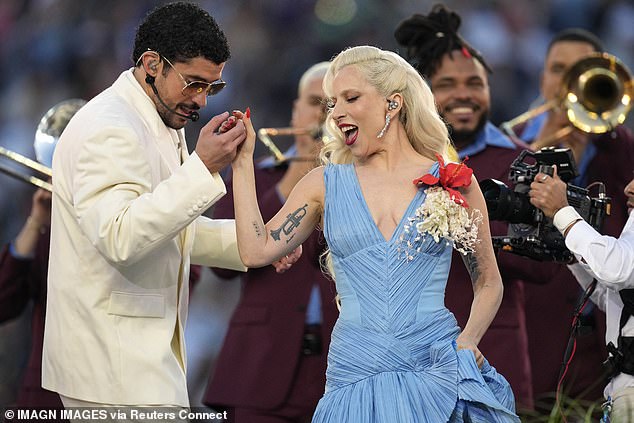
All of it came, as DailyMailUS notes, barely a week after Bad Bunny made Grammy history with an album of the year win for a Spanish-language project, a milestone that pushed him even further into the mainstream spotlight.
Inside Trump’s Halftime Review
Where fans saw celebration, Donald Trump saw an insult.
The U.S. President took to his Truth Social platform with a blistering review. According to DailyMailUS, he called the performance “one of the worst ever” and “absolutely terrible,” objecting not just to the language choice but to the choreography and the overall message of the show.
In his post, Trump complained that “nobody understands a word this guy is saying, and the dancing is disgusting, especially for young children that are watching from throughout the U.S.A., and all over the World.” He went further, arguing that the show “makes no sense, is an affront to the Greatness of America, and does not represent our standards of Success, Creativity, or Excellence.”
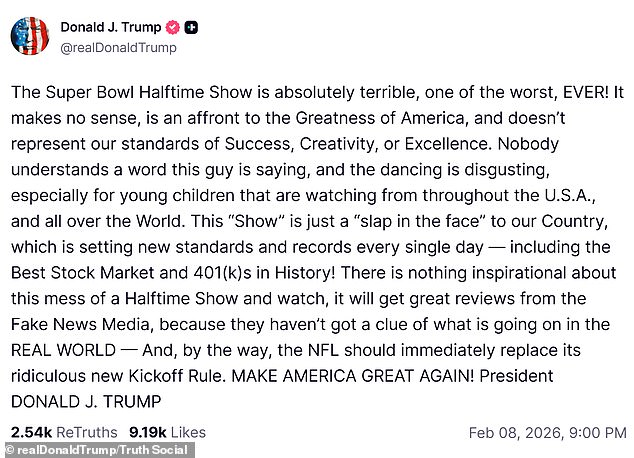
He also framed the performance as a personal swipe at his administration’s narrative of prosperity, writing that the Super Bowl set was “a slap in the face to our Country, which is setting new standards and records every single day, including the Best Stock Market and 401(k)s in History.”
TRUMP UNLOADS on Bad Bunny’s Super Bowl Halftime: “Absolutely terrible”, calls it a “slap in the face” to America!
Scathing Truth Social post ignites culture war firestorm after Spanish-heavy show! pic.twitter.com/wMiAlKntiQ
— Jurisam (@jurisamlegal) February 9, 2026
This was not simply a matter of taste. The language Trump chose pulled the show into his long-running culture-war script, where entertainment, patriotism, and who counts as “American” are constantly up for debate. His specific outrage at an all-Spanish performance, with no English-language songs, turned song selection into a referendum on national identity.
Bad Bunny’s High-Stakes Moment
For Bad Bunny, the halftime stage was more than a gig. It was another chapter in a career built on bending rules of language, genre, and masculinity in front of a global audience.
He has long used his platform to push into politics and protest. During the Trump years, Bad Bunny was publicly critical of immigration enforcement and the treatment of Puerto Ricans, aligning himself with movements that challenged the administration’s policies. That history adds extra voltage to a performance where he singled out countries across North and South America while holding a football stamped with “Together, we are America.”
His set list, according to DailyMailUS, leaned almost entirely Spanish. He reportedly opened with “Titi Me Pregunto” while walking through the constructed sugarcane field, followed by high-energy tracks like “Yo Perreo Sola,” “Safaera,” “Party,” “Voy a Llevarte Pa’ PR,” “EoO,” and “Monaco.” Surrounded by dancers miming harvest work, he paired chart-topping hits with imagery that nodded to labor, land, and everyday life across Latin America.
Visually, he stayed on brand. DailyMailUS describes him in a crisp white short shirt and drawstring trousers, carrying a football in white-gloved hands. The look threaded pop-star glamour with an almost ceremonial formality, as if he were literally carrying the ball for a different vision of who gets centered on football’s biggest night.
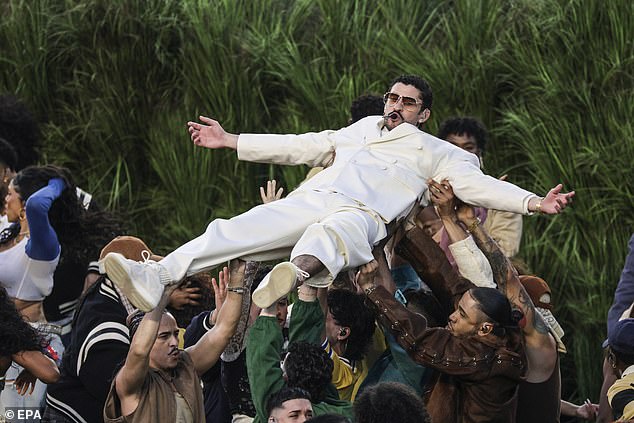
In an earlier prerecorded segment, he appeared to crash through a family’s ceiling, dust himself off, and stride out the front door, a bit of slapstick that doubled as metaphor. The outsider crashing into the living room has been Bad Bunny’s role for years, from Coachella headliner to streaming juggernaut. This halftime show simply brought that energy to the heart of American sports television.
What It Means for the NFL
The NFL now finds itself in familiar territory, caught between political outrage and the business logic of chasing younger, more diverse viewers.
DailyMailUS notes that right-wing pundits and administration officials had already criticized the league once Bad Bunny’s halftime booking was announced. Yet NFL Commissioner Roger Goodell publicly brushed off those concerns after the Grammys triumph, signaling that the league trusted the Puerto Rican superstar to understand the magnitude of the stage and the breadth of the audience.
For the league and its broadcast partners, a halftime show like this delivers global reach, social media dominance, and a halo of relevance. For advertisers, it offers access to Latin and Hispanic audiences who have turned Bad Bunny into one of the most-streamed artists in the world. The staging, the cameos, and the choice to keep the set in Spanish all operate as a high-gloss pitch for a broader definition of American fandom.
Trump’s comments place the NFL in a delicate spot. He is both a former president and a media figure with a devoted base. His charge that the show was “an affront to the Greatness of America” invites some viewers to see the performance not as entertainment, but as a provocation. At the same time, younger fans flooded social platforms with praise, calling the show “a love letter” to Latin and Hispanic culture and celebrating that the biggest stage in U.S. sports sounded like their homes.
Halftime shows have triggered this kind of split before, from Janet Jackson and Justin Timberlake’s wardrobe controversy to the 2020 “Latina power” set from Jennifer Lopez and Shakira that some conservative figures also criticized. Bad Bunny’s performance fits into that lineage, but with a twist. Language itself became the flashpoint, sharpening the question of who gets to feel included in a night that brands still market as universal.
As the NFL tallies ratings, social engagement, and global press, the long-term legacy of this halftime show may not be decided in the comments under Trump’s post or in the applause of Bad Bunny’s fans. It will be written in who the league books next, how boldly artists lean into their own cultures, and whether “Together, we are America” feels like a slogan or a promise the sport is ready to keep.
Join the Discussion
Do you see Bad Bunny’s all-Spanish Super Bowl halftime show as a unifying moment for American culture, or as a performance that left some viewers feeling shut out?
References