

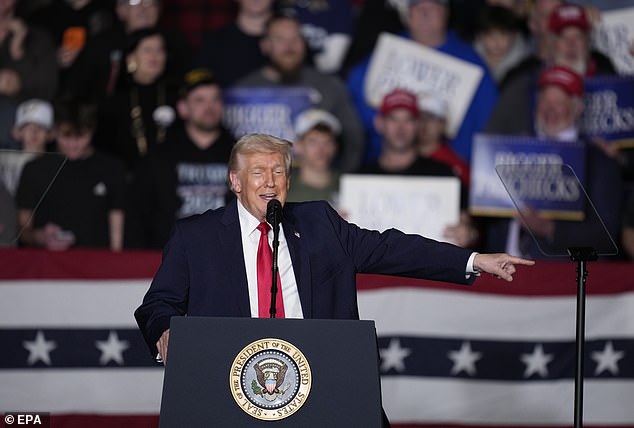
It was supposed to be an easy sell on the economy to a friendly crowd in Clive, Iowa. Instead, President Donald Trump cut himself off mid-sentence, turning toward the stands as a protester’s shouts ripped through the room, shifting the mood.
The 79-year-old president was there to discuss his first year back in office and to convince supporters that his administration was rewriting the story of a shaky economy. What unfolded instead was pure Trump theater, complete with hecklers, chants, and one very pointed fantasy about how different his presidency could be without them.
The Rally That Turned Into a Showdown
About thirty minutes into his remarks, Trump had been ticking through a familiar list of talking points. Clean energy standards. Ethanol. Tariff-enabled funding for farmers. 401(k) savings accounts. As he praised what he described as a roaring economy, the first wave of protest crackled to life.
According to the DailyMailUS report, the president was bragging about the state of trade when the shouts began. He had just told the crowd, ‘After years of the United States getting ripped off by other countries on trade. I’m standing up for the workers and the farmers of our country like no other president has ever no other president has done this,’ when the interruption grew too loud to ignore.
Trump paused, then went straight to the noise. He labeled the disruptors ‘paid insurrectionists’ and, in a few words, gave the crowd a glimpse into the alternate reality he says he turned down. ‘I could have an easy presidency,’ he said, framing himself as a man who chose conflict over comfort.
Then came a darker flourish. Trump told the audience, ‘I’d probably have this little piece of ear back,’ referencing the portion of his ear that was hit by Thomas Matthew Crooks’ gunfire in Butler, Pennsylvania. In a single aside, he linked a chaotic protest in Iowa to the most dramatic moment of his political life.
‘I Wouldn’t Have to Listen To Lunatics’
For Trump, the hecklers were not just loud. They were proof that his job is more complicated than it has to be. ‘I wouldn’t have to listen to lunatics like this up there. I wouldn’t have to listen,’ he said, as security and law enforcement moved quickly to contain the disruption and the noise subsided.
The crowd responded on cue. Attendees pushed back verbally at the agitator, and a familiar chant rose from the seats. Cries of ‘USA, USA, USA’ filled the space, turning a jarring interruption into a patriotic call and response that his rallies have leaned on for years.
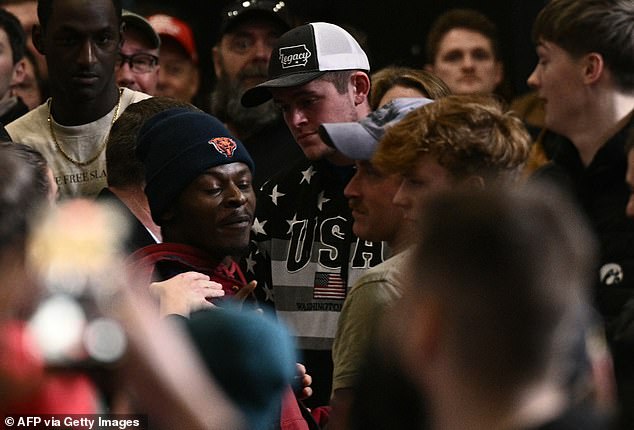
Within moments, the tension had been absorbed into the spectacle. Trump had vented, his supporters had roared, and the stage was reset. The protester became part of the show, a foil for a president who thrives on confrontation as much as applause.
From Chaos Back to the Script
Then, as if flicking a switch, Trump went back to his prepared narrative. In what observers describe as his signature ‘weave,’ he used the clash to pivot once more to his favorite political antagonist, Joe Biden.
‘Under sleepy Joe, we had the largest trade deficit in world history,’ Trump declared, attacking his predecessor and contrasting that image with his own promises to protect American workers. The speech, which had briefly looked like it might spiral off course, snapped back into place.
The quiet did not last. Minutes later, another outburst from the audience erupted, and Trump turned his fire on the protesters again. ‘They’re paid. They get paid. These are all paid agitators. That’s all they are,’ he told the crowd, insisting the demonstrators were not organic critics but hired antagonists.
He pushed the rhetoric further, repeating his earlier label. ‘They’re paid insurrectionists,’ he said. ‘They’re sickos.’ The words landed with force, drawing a clear line between loyal supporters and the people he portrayed as bought and unhinged.
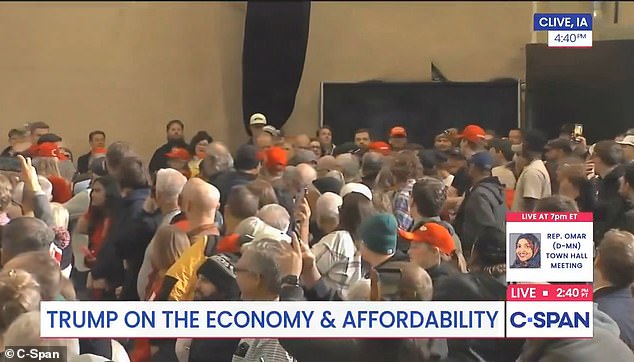
Then, once more, he moved on. The pattern was unmistakable. An interruption, a rebuke, a punchline, and an almost seamless glide back to the talking points that his team believes can rescue his political fortunes.
Remaking the Economic Storyline
Beneath the drama, this trip to Iowa was about one thing: rewriting the narrative around the economy. The DailyMailUS report notes that inflation and the economy rank as top concerns for American voters in a recent Daily Mail and JR Partners poll, and those worries have been a drag on Trump’s poll numbers and overall approval.
Trump insisted that reality looks far brighter. He claimed that the stock market had hit 52 all-time highs and that $9 trillion had been added to Americans’ retirement and 401(k) accounts. The report points out that the market did notch numerous record highs in 2025 despite significant volatility, but that the 9 trillion dollar figure is likely an exaggerated account of actual retirement growth.
What mattered in the room, though, was not the fine print. Trump cast himself as the singular champion of the people before him. He reminded them that, ‘After years of the United States getting ripped off,’ he is ‘standing up for the workers and the farmers’ in a way he insists no other president has.
The policy details he cited told the same story. Clean energy standards packaged as wins for American jobs—ethanol framed as a promise kept to heartland producers. Tariff-enabled funding is painted as proof that he is willing to fight trading partners. Savings in 401(k) plans are described as evidence that his leadership is padding their future.
The Reality Star President Still on Stage
If you have watched Trump for years, the Iowa clash felt almost familiar. Before he was president, he was the face of primetime television, firing contestants and presiding over boardroom drama on “The Apprentice.” On this night, the set was a political stage in Clive, but the instincts looked very much the same.
There was the villain, in the form of a shouting protester high in the crowd. There was the hero, casting himself as a survivor of gunfire who could have chosen a quiet life but stayed in the arena. There was the storyline, looping back constantly to his claim that under his watch, the economy is recovering, and the forgotten are finally being heard.
Even his line about an easier path sounded like a crafted beat. ‘I could have an easy presidency,’ he told the room, presenting the idea not as a confession of fatigue but as an applause line about sacrifice. The suggestion that he ‘wouldn’t have to listen to lunatics’ without the job only sharpened the contrast between comfort and combat.
For his supporters in Clive, the protests were a brief annoyance that gave them one more chance to chant and cheer. For his detractors, the language of ‘paid insurrectionists’ and ‘sickos’ will read as another escalation in a long-running war of words. What no one can deny is that Trump still knows how to turn disruption into drama, and drama into a story about himself.
On this Iowa night, the president who once ruled a television soundstage showed he is still directing the action, using every shout, every chant, and every unscripted moment to keep the spotlight exactly where he wants it.